Interactive Perspective Multi-Surface Mural — Project Proposal
Author: Sergio Herrera
Date: September 2026
Brief
This proposal describes an interactive installation in which participants use handheld mobile devices as drawing canvases to create perspective murals (trompe-l’œil) on physical surfaces in real time. Room-mounted projectors display the artwork with the correct perspective distortion, so it appears aligned with the viewpoint from which each participant aimed their device.
Installation layout
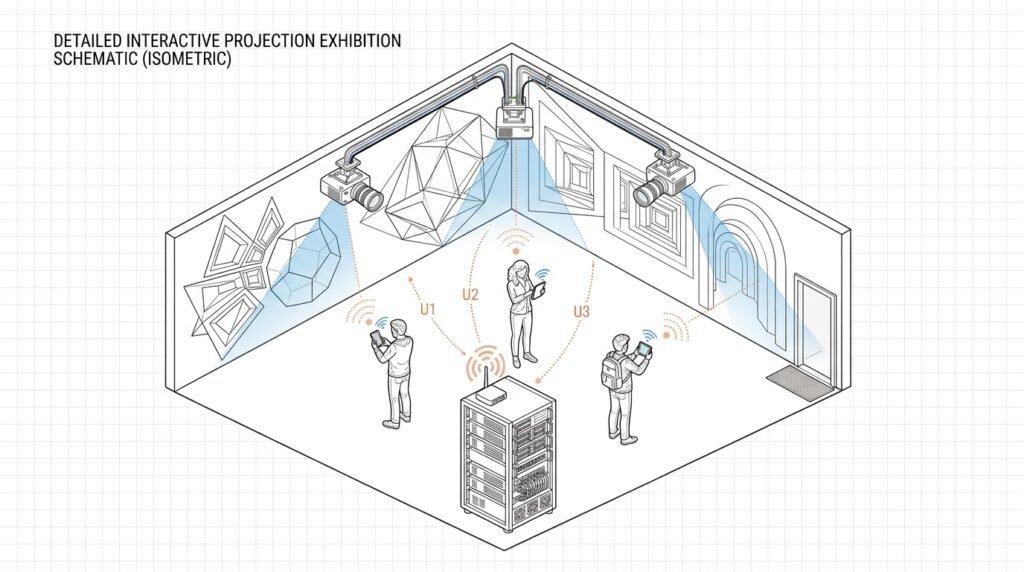
How the installation works
1. Enter with a canvas — Each participant uses a mobile device that acts as a personal drawing surface.
2. Draw and aim — Users freely draw and point the device around toward the installation surfaces from any viewpoint.
3. Capture pose — The device camera estimates its position and orientation relative to the known surface geometry.
4. Compute distortion — The system warps the drawing so it would look correct if projected from that viewpoint onto each surface.
5. Physical reprojection — One or more projectors render the distorted artwork onto the walls, matching the participant’s chosen perspective.
6. Interact and persist — Users iterate in real time; when satisfied, they can *affix* their artwork at a chosen viewpoint for others to observe and build upon.
Background
The idea extends an existing prototype (bonzolabs/multi-plane-virtual-projector) that already solves the geometry of projecting shapes onto multiple planes.
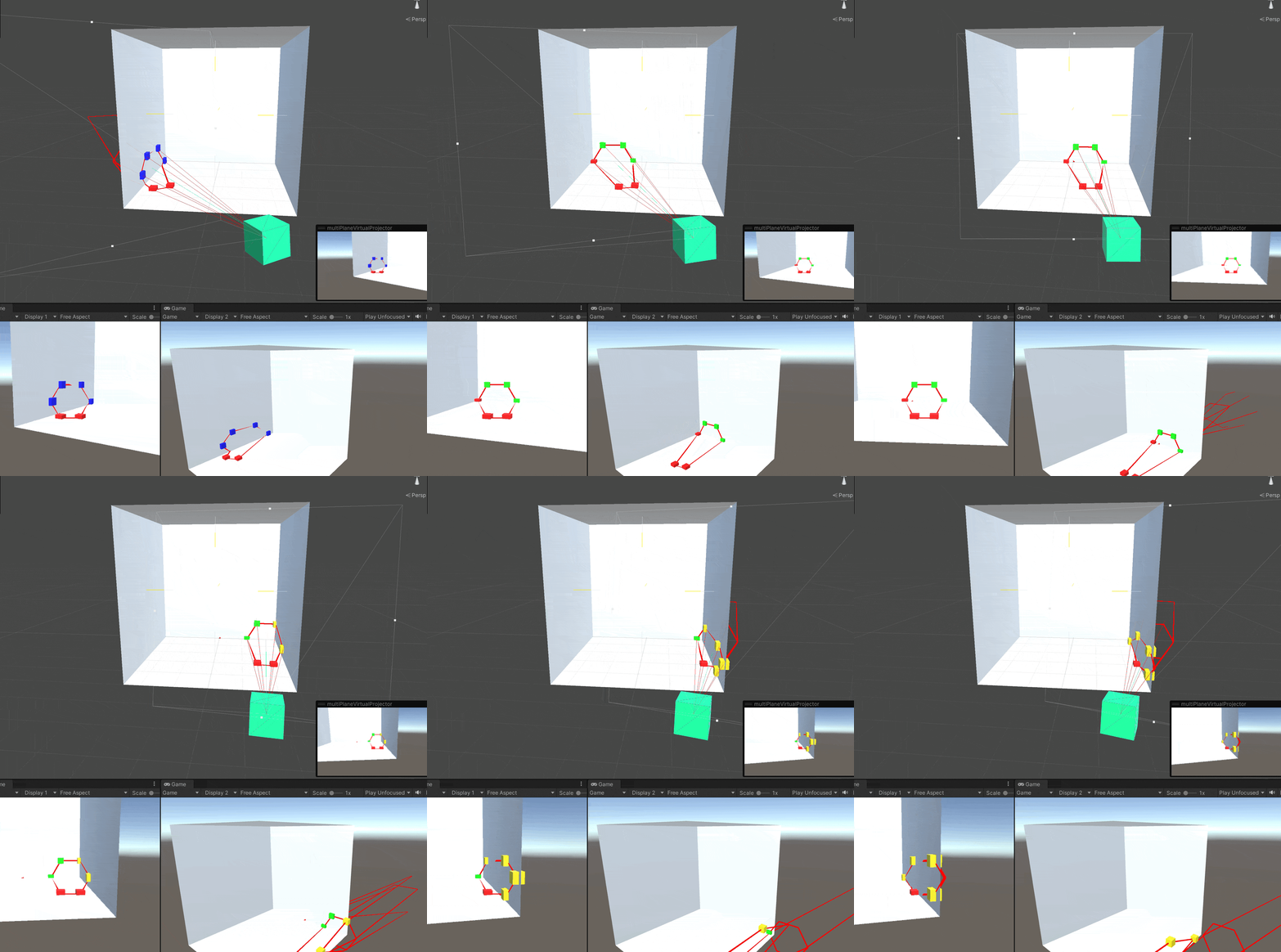
This proposal covers what is needed to turn that offline tool into a live, interactive installation.
The existing prototype was built to help mural artists plan perspective artwork without a physical projector on site: given a viewpoint and a set of mural planes, it computes where drawn shapes would appear on each surface.
This installation describes then an interactive version of that model, in which participants move freely in the room, draw on personal devices, and see their work appear on the walls through real projectors — collaboratively and in real time.
What needs to be built
Beyond the existing projection core, the installation requires:
– A mobile drawing app with touch input and camera-based tracking.
– A host machine that receives drawings and device poses, and drives the projectors.
– Set Venue setup to define the mural surfaces and align the projectors (once per location).
– Interactive session handling for multiple participants: active drawings, fixed artworks, and hand-off between users.
Resources
Software — Mobile app development; host application for the installation hub.
Hardware — Mobile devices for participants; one or more video projectors; a host machine running the system.
When is the installation working?
1. A participant can draw on a mobile device, point it at the surfaces, and see the artwork appear correctly distorted on the physical walls with no noticeable delay.
2. Two or more participants can interact at the same time without interfering with each other’s work.
3. A participant can affix an artwork at a chosen viewpoint; others then interact within their on perspective of the surfaces.
Open questions
– How many participants simultaneously?
– Marker-based or markerless camera tracking — what suits the target venue?
– One projector per surface, or fewer projectors covering multiple walls?
– Should fixed artworks remain indefinitely, fade over time, or be cleared between sessions?
– Mobile platform: web app, native app, or other?
References
– Trompe-l’œil – https://en.wikipedia.org/wiki/Trompe-l%27%C5%93il
– Camera Calibration – https://bonzolabs.com/camera_calibration/
– Multi-Plane Virtual Projector – https://bonzolabs.com/multi-plane-virtual-projector/